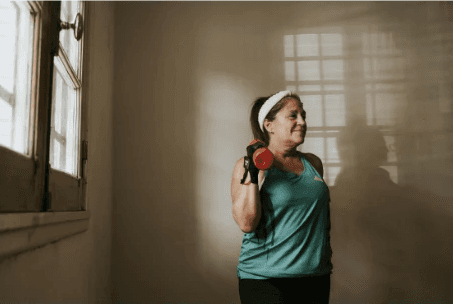
What Counts as Exercise
If you have ever thought "I should be exercising more," there is a good chance you are making this harder than it needs to be. Most people carry around a very narrow definition of what counts. They picture intense workouts, long gym sessions, and being wiped out at the end. If it does not look like that, they assume it does not matter.
What actually counts as exercise?
Exercise is movement you choose on purpose to make your body better at life. That includes a Pilates class, a brisk walk with a friend, dancing while you clean, gardening and yard work done with some momentum, and yes, pickleball. If your body is moving and working, and you are doing it intentionally, it counts. It does not have to be extreme to be effective.

Why this gets confusing
We have been taught that exercise only counts if it is hard, structured, and uncomfortable. So when something feels moderate, social, or even enjoyable, we dismiss it. Which is backwards, because moderate, social, enjoyable movement is exactly the kind most people can do consistently. This is something we reinforce all the time in our West St. Louis County studio: exercise does not have to be complicated to work.
Where intensity fits in
There is a place for challenge. Your body does need to be pushed enough to adapt. But that does not mean every workout has to be hard or leave you exhausted. Most people make better progress when some days are genuinely challenging and other days are simply consistent.
Why this matters more than you think
When your definition of exercise is too narrow, you build a system you cannot sustain. You wait for enough time, enough energy, and the right conditions, and when those do not show up, you do nothing at all. Broaden what counts and everything gets easier: staying consistent, adjusting to a busy week, and staying within your capacity so you do not overload your system. If you read The Cup of Resilience, you already know why that last part matters. When movement is simple and repeatable, your body can actually adapt to it.
The reframe
Instead of asking "did I work out hard enough?", try asking "did I move in a way that supports my body today?" That one question will change how your whole week looks.
What Counts as Exercise
If you have ever thought "I should be exercising more," there is a good chance you are making this harder than it needs to be. Most people carry around a very narrow definition of what counts. They picture intense workouts, long gym sessions, and being wiped out at the end. If it does not look like that, they assume it does not matter.
What actually counts as exercise?
Exercise is movement you choose on purpose to make your body better at life. That includes a Pilates class, a brisk walk with a friend, dancing while you clean, gardening and yard work done with some momentum, and yes, pickleball. If your body is moving and working, and you are doing it intentionally, it counts. It does not have to be extreme to be effective.
Why this gets confusing
We have been taught that exercise only counts if it is hard, structured, and uncomfortable. So when something feels moderate, social, or even enjoyable, we dismiss it. Which is backwards, because moderate, social, enjoyable movement is exactly the kind most people can do consistently. This is something we reinforce all the time in our West St. Louis County studio: exercise does not have to be complicated to work.
Where intensity fits in
There is a place for challenge. Your body does need to be pushed enough to adapt. But that does not mean every workout has to be hard or leave you exhausted. Most people make better progress when some days are genuinely challenging and other days are simply consistent.
Why this matters more than you think
When your definition of exercise is too narrow, you build a system you cannot sustain. You wait for enough time, enough energy, and the right conditions, and when those do not show up, you do nothing at all. Broaden what counts and everything gets easier: staying consistent, adjusting to a busy week, and staying within your capacity so you do not overload your system. If you read The Cup of Resilience, you already know why that last part matters. When movement is simple and repeatable, your body can actually adapt to it.
The reframe
Instead of asking "did I work out hard enough?", try asking "did I move in a way that supports my body today?" That one question will change how your whole week looks.
What Counts as Exercise
If you have ever thought "I should be exercising more," there is a good chance you are making this harder than it needs to be. Most people carry around a very narrow definition of what counts. They picture intense workouts, long gym sessions, and being wiped out at the end. If it does not look like that, they assume it does not matter.
What actually counts as exercise?
Exercise is movement you choose on purpose to make your body better at life. That includes a Pilates class, a brisk walk with a friend, dancing while you clean, gardening and yard work done with some momentum, and yes, pickleball. If your body is moving and working, and you are doing it intentionally, it counts. It does not have to be extreme to be effective.
Why this gets confusing
We have been taught that exercise only counts if it is hard, structured, and uncomfortable. So when something feels moderate, social, or even enjoyable, we dismiss it. Which is backwards, because moderate, social, enjoyable movement is exactly the kind most people can do consistently. This is something we reinforce all the time in our West St. Louis County studio: exercise does not have to be complicated to work.
Where intensity fits in
There is a place for challenge. Your body does need to be pushed enough to adapt. But that does not mean every workout has to be hard or leave you exhausted. Most people make better progress when some days are genuinely challenging and other days are simply consistent.
Why this matters more than you think
When your definition of exercise is too narrow, you build a system you cannot sustain. You wait for enough time, enough energy, and the right conditions, and when those do not show up, you do nothing at all. Broaden what counts and everything gets easier: staying consistent, adjusting to a busy week, and staying within your capacity so you do not overload your system. If you read The Cup of Resilience, you already know why that last part matters. When movement is simple and repeatable, your body can actually adapt to it.
The reframe
Instead of asking "did I work out hard enough?", try asking "did I move in a way that supports my body today?" That one question will change how your whole week looks.